How One Title I School Turned a 33% Science Forecast Into 51.4% Profiency

At one South Atlantic middle school, consistent use of BrainPOP Science was associated with higher science performance, especially among students who entered the year needing the most support.
Middle school science teachers face high expectations, often with limited time and resources.
There are new standards to navigate, state assessments to prepare for, and students with different levels of background knowledge, reading proficiency, and support needs. Teachers may be responsible for well over 100 students, making it difficult to provide every learner with the individual attention they need.
A BrainPOP Science study in a large, diverse South Atlantic public school district followed 92 eighth-graders at one Title I middle school over the 2024–2025 academic year. The study compared each student’s actual test performance with the score predicted by the state, while controlling for prior academic history and student demographics.
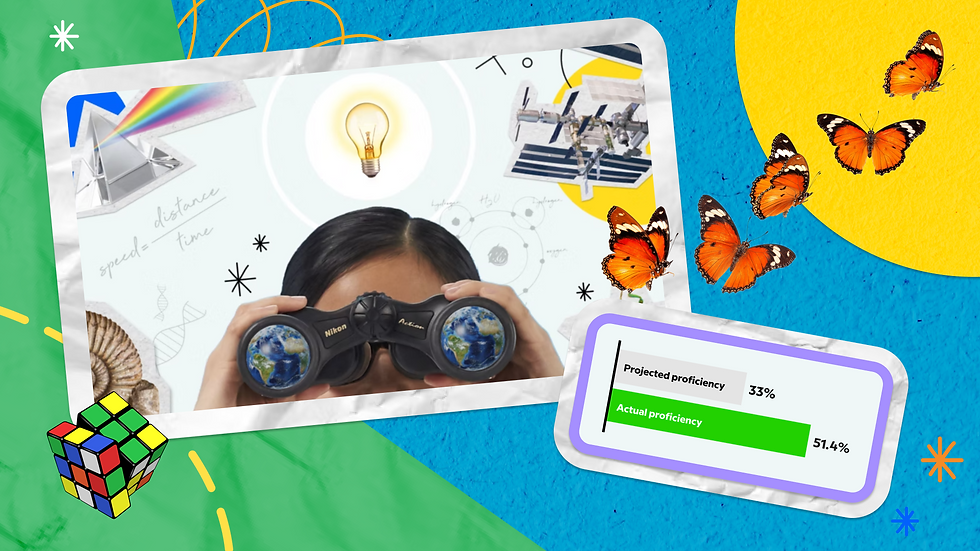
The stakes were high. State models projected the school would reach just 33% science proficiency, putting it on track to receive a failing state school grade. By the end of the year, actual science proficiency had reached 51.4%, more than 18 percentage points above the state projection. The school’s state grade also moved from a D to a C.
What may have contributed to these gains?
Extending what one teacher can do
Strong instruction starts with the teacher. But even the strongest teacher can’t give every student the one-on-one support they may need at the moment.
One eighth-grade science teacher captured that challenge when she described BrainPOP Science as “another tutor in the room.”
BrainPOP Science can extend teacher capacity by giving students structured ways to investigate scientific questions, work with data and evidence, and check their understanding while the teacher guides discussion, responds to misconceptions, and provides targeted support.
The goal isn’t to replace teacher-led instruction. It’s to give teachers another way to reach students with different needs while keeping them actively involved in the science.
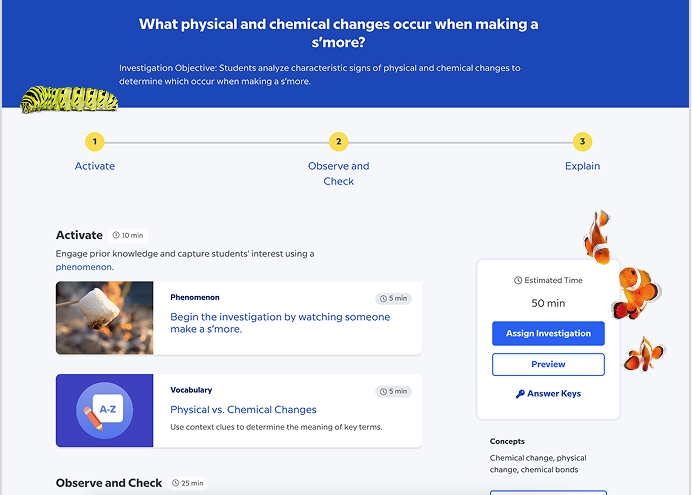
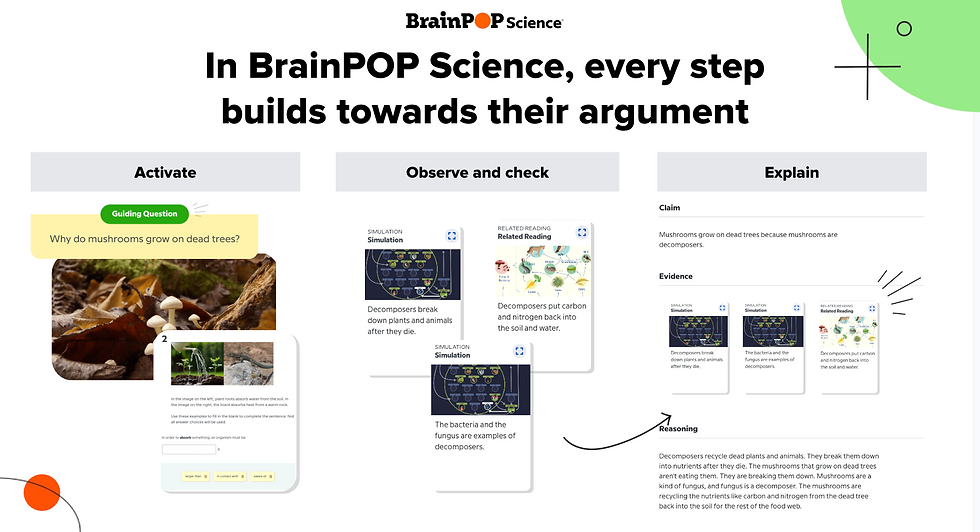
One way BrainPOP Science does that is through a three-part investigation that builds toward a scientific argument: Activate, Observe & Check, and Explain.
Here’s what that looks like in practice.
Activate with accessible phenomena
BrainPOP Science investigations begin with curiosity-driven scientific questions such as Why can’t you unbake a cake? or Why do mushrooms grow on dead trees?
The real-world phenomena behind those questions give students a shared starting point before they begin engaging with more complex scientific texts, models, or data. They create a reason to wonder, surface, and discuss ideas, and begin investigating.
BrainPOP Science also introduces vocabulary early, so students encounter important scientific language before they need to use it in more complex contexts. That can be especially helpful for multilingual learners and readers who need additional support. It gives them more opportunities to build and apply understanding as the investigation progresses.
Observe and check through multimodal data
Next, students build on their initial observations through active investigation.
BrainPOP Science uses interactive simulations, data manipulatives, and real-world datasets to help students observe patterns, explore relationships, and gather observations that can become evidence in their Claim-Evidence-Reasoning (CER) .
Tools such as PhET interactive simulations and Desmos graphs featuring authentic scientific datasets let students manipulate variables and see how different factors affect what happens.
Rather than simply looking at a static chart or watching something happen on a screen, students interact with the data and observe the results for themselves.
As they work, students save qualitative and quantitative observations to use as evidence in their scientific argument or explanation. Built-in checkpoints also give teachers information they can use to target support and to decide what students may need next.
Multiple ways to access the science, paired with timely feedback, can be especially important for students who find traditional text-heavy, static materials challenging. One eight-grade science teacher noted that making scientific ideas more understandable for students can also help build confidence.
Explain and synthesize through embedded CER
Students build toward a scientific argument or explanation throughout the investigation, culminating in a CER response.
By the time students reach the CER, they can draw on the observations, vocabulary, and scientific concepts they’ve developed throughout the investigation to make a claim, support it with relevant evidence, and explain their reasoning.
Literacy is embedded throughout the investigation as students read scientific texts, develop vocabulary, interpret evidence, discuss ideas, and communicate scientific arguments and explanations in writing.
In the South Atlantic study, those literacy connections were reflected in students’ ELA results as well.
The results: gains beyond the state projection
Students who used BrainPOP Science regularly performed significantly better on the state science assessment.
Those who engaged with BrainPOP Science at least six times gained more than 8 percentile points above their predicted scores, a statistically significant difference.
The largest gains appeared among students who began the year needing the most support. Students in the bottom 25% of baseline performance gained nearly 12 percentile points with regular BrainPOP Science use.
The study also found a statistically significant increase in ELA scores among students who used BrainPOP Science regularly. That suggests the reading, vocabulary, writing, and evidence-based reasoning students practice in science also supports literacy development across subjects.
Together, the findings suggest that repeated opportunities to work actively with scientific ideas support both science performance and the literacy skills students use to explain what they know.
Three takeaways for science educators and school leaders
The experience at this South Atlantic middle school offers several strategies other educators can carry into their own classrooms.
Build vocabulary across the investigation.
Introduce important scientific terms in meaningful contexts, then give students repeated opportunities to encounter, use, and apply that language as they investigate, discuss, and explain science.
Use simulations and data to make abstract science concepts more accessible.
Interactive models and real-world data give students another way to explore a concept, especially when text or static diagrams alone don't make the idea clear.
Collect evidence along the way.
Rather than waiting until the final CER to think about evidence, have students collect strong observations as they investigate. They can select from those observations to use as evidence when they construct and defend a claim.
Building capacity and confidence
The South Atlantic school began the year with a state projection of 33% science proficiency. It ended with 51.4% proficiency and a higher state school grade.
But assessment performance is only one part of the picture. BrainPOP Science also gives teachers another way to support students, especially when one-on-one attention is limited.
As students investigate questions, work with data and evidence, and build scientific explanations, they strengthen the skills they need for both state assessments and deeper science learning. Just as important, they build the confidence to approach new challenges with a stronger sense that they can figure things out.
Jackie Glassman is a writer and content strategist who builds meaningful learning experiences that meet K–8 students where they are. She was part of the early team that helped shape BrainPOP Science when it was still just a kernel of an idea. Jackie blends rigor, empathy, and creativity to develop standards-aligned, culturally responsive curriculum rooted in how students truly learn. She is also a dedicated yogi, and her favorite character will always be Moby.


Comments