How BrainPOP Aligns to Universal Design for Learning (UDL) Guidelines

Updated: Mar 20
Every brain works a little differently—so it follows that every student learns a little differently. They also come from different backgrounds, interests, skills, and contexts. So, how do we meet every student where they are? More specifically, when there are 20+ different brains in one classroom, how does a teacher create learning experiences that resonate with each student?
Universal Design for Learning (UDL)
Enter the Universal Design for Learning (UDL). The Center for Applied Special Technology, or CAST, has suggested that learner variability is predictable—and has provided educators with UDL Guidelines for learner agency. This agency can be fostered by providing learners with options: multiple means of engagement (the why of learning), representation (the what of learning), and action and expression (the how of learning).
That’s where using educational tools with embedded UDL is key—and, luckily, BrainPOP does just that. BrainPOP is built specifically to support all kinds of learners using UDL guidelines to support all kinds of learners.
“I find myself thinking, how can learning be helpful? And that’s starting with the student’s learning journey,” says Dr. Barbara Hubert, BrainPOP’s Sr. Director of Learning Design of BrainPOP. “We can look at that student learning journey, and think about the beats, cadence, and hold that UDL framework as a guide proactively as [we] enter the design process. Also, consider adding diverse voices and perspectives along the design process.”
Below are only a few of the many ways BrainPOP bakes those UDL practices right into the experience.
BrainPOP and Universal Design for Learning (UDL)
Multiple Means of Engagement
BrainPOP meets students where they are by offering engaging entry points for everyone.
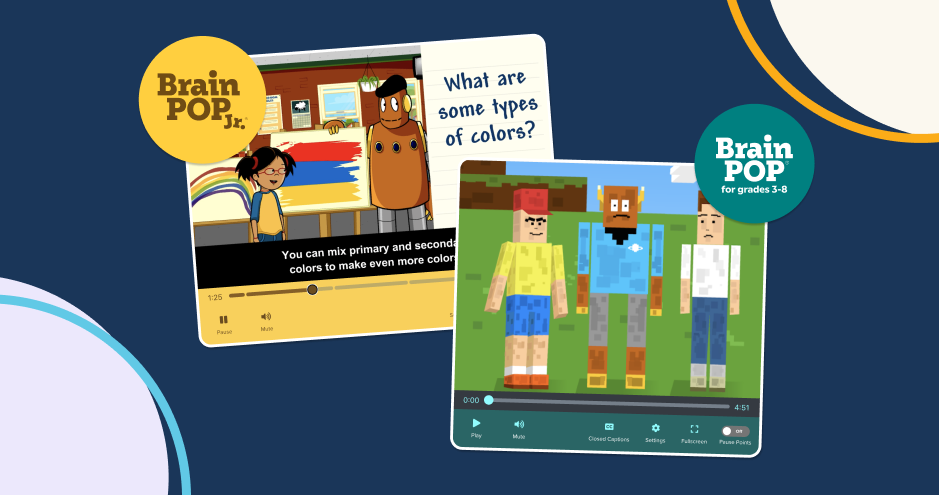
BrainPOP Jr., BrainPOP (for grades 3-8), and BrainPOP ELL bring learning to life through animated movies that capture students' attention and make challenging topics feel approachable.
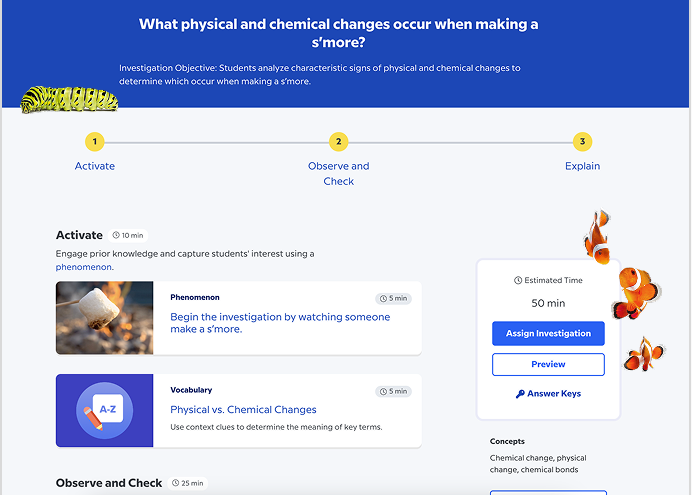
BrainPOP Science takes a different approach. Real-world phenomena and engineering projects connect students' experiences to the science behind them. So students can see how science is relevant in their daily lives—creating those aha! moments that make learning stick.
When students choose how they engage with content, they're not just completing assignments; they're genuinely excited to learn.
Multiple Means of Representation
With BrainPOP, students can access content through text, audio, video, simulations, and more—helping them understand the material in a way that makes sense to them.
BrainPOP Jr. and BrainPOP (for grades 3-8) provide background knowledge-building movies with closed captioning, speed controls, and Microsoft Immersive Reader. These features ensure that every student—whether they're multilingual learners, students with different reading levels, or those who simply need to slow down and process—can access the content in a way that works for them.
BrainPOP ELL's activities, like Hear It, Say It, let students learn through listening, then record and play back their own voices to practice speaking. This multimodal approach helps students build confidence while developing essential communication skills.
BrainPOP Science goes even further with simulations and data manipulatives that let students process information through interaction. Instead of reading about science concepts, students can manipulate variables, observe outcomes, and make sense of complex ideas.
When content is represented in multiple ways, understanding becomes accessible to everyone.
Multiple Means of Action and Expression
BrainPOP lets students demonstrate their knowledge in different ways—from drawing and acting to writing and speaking.
BrainPOP Jr. and BrainPOP offer students choices. Want to speak your answer? Draw it? Type it out? Create a movie about it? Go for it! Students can showcase their understanding in the format that works best for them, moving beyond a one-size-fits-all assessment.
BrainPOP ELL provides a rich variety of activities—Word Play, Hear It, Say It, and Write It—that allow students to demonstrate their reading, writing, speaking, and listening skills in different ways. This variety ensures that all language learners can show off what they've mastered.
BrainPOP Science scaffolds writing in science, starting with low-stakes observations and building toward full Claim-Evidence-Reasoning statements. Students develop their scientific thinking one step at a time, scaffolding up to writing the more complex paragraphs they’ll need for evidence-based writing.
Learning That Works for Everyone
When you design with UDL principles from the start, something remarkable happens: what's necessary for some students (with, say, IEPs) ends up helping all students.
Ready to unlock every student's potential? Learn more about BrainPOP and discover how UDL can transform your teaching.
AnnaLiese Burich is a Product Marketing Manager at BrainPOP. In addition to holding an MA in Magazine Journalism and an MA in English Literature, she has worked in (and written for) the edtech space from every angle: from parenting tips and children's activities to classroom strategies and district goals. AnnaLiese's favorite BrainPOP character is Tim.


Comments