THE CHALLENGE
Grade-level learning assumes one-size-fits-all
Most grade-level materials are designed for one way of learning—they work well for some students, and create new barriers for others. When content isn't presented with multiple entry points, educators end up rewriting materials, finding alternate texts, or creating parallel activities. That's extra prep time that takes away from actual teaching.
WHY TEACHERS CHOOSE BRAINPOP
One lesson that works for every learner
BrainPOP explains grade-level concepts through animated storytelling, built-in scaffolds, and flexible activities, so students with different learning needs can learn alongside their peers, without you creating separate lessons.
Break down big ideas into manageable pieces
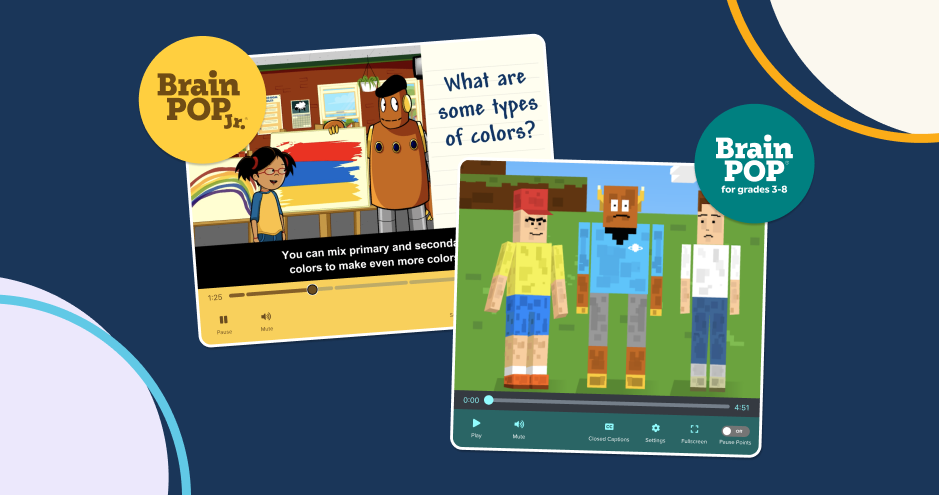
Animated storytelling breaks concepts into small, sequenced steps with visual supports, so students can process information without cognitive overload while they make connections across subjects.
Show the “why” alongside the “what”
Concrete examples and real-life situations help students link new information to what they already know, building true understanding beyond just recall.
Make understanding visible in more than one way
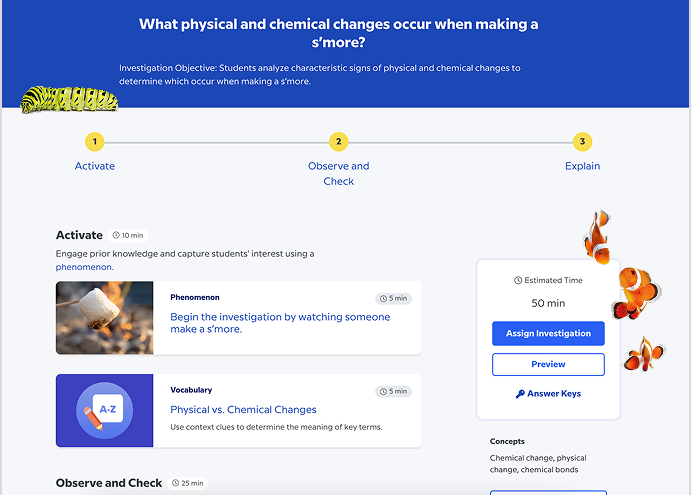
Built-in activities let students explore and demonstrate understanding without requiring you to create separate materials.

Multiple means of representation
Students can access ideas through video, audio, text, visuals, and vocabulary support—helpful when reading level, background knowledge, or language skills vary.

Multiple means of engagement
Students can participate through viewing, interacting, collaborating, and creating—supporting attention, motivation, and persistence when tasks are challenging.

Multiple means of expression
Students can demonstrate learning in different formats and modalities, so performance reflects understanding—not just one preferred output type.
Universal Design for Learning
Flexibility that supports UDL
BrainPOP is designed with UDL in mind so students have options for accessing content and showing understanding—and you spend less time adapting materials to fit learner needs.
Join our mailing list to get the latest news, product updates, and content straight to your inbox.
Join our mailing list to get the latest news, product updates, and content straight to your inbox.
MULTI-TIERED SYSTEM OF SUPPORTS
Support across MTSS tiers
Tier 1
Universal support
Use BrainPOP topics to build shared background knowledge and give all students options for accessing content and demonstrating understanding.
Tier 2
Targeted support
Use BrainPOP activities for small-group instruction to reteach key concepts, reinforce vocabulary, and practice skills with added scaffolds.
Tier 3
Individualized support
Use BrainPOP to target foundational skills, build background knowledge, and reinforce understanding so students can actively participate in classroom lessons and discussions.
TESTIMONIALS
Why teachers love BrainPOP
“BrainPOP allows me to differentiate my lessons easily. For example, when working with collaborative special education classes, many built-in features in BrainPOP allow all students to succeed, such as closed captioning, pre-recorded vocabulary, student choice, prompts for Make-a-Movie, and more! All students should have the opportunity to learn and have fun!”
Dinah Wade, Teacher, TN
“BrainPOP helps differentiation and leveled learners. I can assign different tasks to different students so that each learner gets a reading or video or assignment tailored to their abilities.”
Brooke Alvine, Teacher, NJ
BrainPOP Blog
Frequently Asked Questions
Yes. Every BrainPOP movie includes closed captions and a full transcript. Captions are easy to toggle on and off before or during a movie, and work for a wide range of students—including students who are deaf or hard of hearing, English learners, and anyone who processes information better when they can see and hear it at the same time.
Absolutely. BrainPOP movies run five to seven minutes, and built-in Pause Points break up passive viewing. After the movie, assignments let you chunk content into smaller steps. And, throughout all of BrainPOP, the format never changes—the same characters, the same structure, every time—which gives kids who need predictability exactly that.
Yes. BrainPOP integrates with Microsoft Immersive Reader for text-to-speech and reading customization, supports keyboard navigation, and includes captions and transcripts on every video. Audio descriptions are available on all movies for students who are blind or have low vision. For the complete picture, visit brainpop.com/discover/accessibility.
Yes. Through BrainPOP’s assignments, you can differentiate and sequence tasks to match individual student needs, and assign movies, quiz levels, or activity types to different students—same topic, same content, no separate lesson plans.
Many districts do. BrainPOP supports individual accommodations, provides universally accessible content, and aligns directly with the IDEA initiatives. We recommend starting the conversation with your special education director or IDEA coordinator—our funding page has the talking points you need to show how BrainPOP aligns.
Have specific questions about your school or district? A BrainPOP representative can help.
Yes—across all three principles. Movies, captions, and Connected Texts at multiple reading levels with built-in scaffolds give every student a way into the content. Tim and Moby's familiar characters and humor keep students present, while Pause Points create natural moments to check in.
When it's time to show what they know, quizzes, Make-a-Movie voiceovers, and Creative Coding give every student a way to demonstrate understanding—the student who can't write can still show you everything they know. See how it works in practice.
Yes—for every student, every topic, and every individual IEP goal area. Closed captions, adjustable playback speed, and Vocab Builder are built directly into the core BrainPOP experience, so every student enters the lesson through the same door as their peers—and for reading comprehension goals specifically, Connected Texts extends that same access into literacy.
Students get short, high-interest texts tied to the BrainPOP topic they just watched, available at multiple reading levels with built-in scaffolds to support confidence. No separate track. No pulled-aside moment. For more targeted support, assignments let you break lessons into smaller segments and differentiate tasks by student—without running a parallel lesson plan.
Quite a few—BrainPOP has multi-modal scaffolds that address a wide spectrum of cognitive, processing, and executive functioning needs.
-
Audio and visual anchors: Closed captions and full transcripts provide immediate support for students with hearing differences or auditory processing challenges, while adjustable playback speed gives working memory the necessary time to process information.
-
Reading scaffolds: Connected Texts pair short, high-interest texts with the BrainPOP topic students just watched—available at multiple reading levels, with built-in scaffolds to support confidence and comprehension. For additional text support, Microsoft Immersive Reader is embedded directly into written content to provide text-to-speech, syllable highlighting, and instant translation.
-
In-the-moment guidance: Built-in hints provide a supportive, low-stakes nudge to keep students thinking through questions without giving away the answer, while built-in rationales (that pop up after students answer) explicitly explain the "why" behind correct choices to instantly reinforce and lock in comprehension.
-
Executive functioning and vocabulary: The Vocab Builder provides exposure to high-frequency academic words in context. Meanwhile, the assignment function allows you to chunk and sequence lessons into smaller, manageable steps to reduce cognitive load.
-
Collaborative and multi-modal extension: Live Mode transforms quizzes into real-time, whole-class collaborative experiences that lower the barrier to participation and activate prior knowledge. For students who thrive away from the screen, tactile Unplugged activities extend the lesson into offline, discussion-based, and collaborative learning experiences.
-
Yes, and this is one of the most common ways special educators create a consistent learning experience. A single BrainPOP movie gives every student—regardless of reading level, language background, or disability category—access to the same content through a shared starting point. From that shared starting point, you can differentiate what comes next using different activity types.
Yes. Since BrainPOP delivers content through animated video and audio narration, reading isn't a prerequisite for accessing grade-level material. That's exactly why teachers use it first: the student who would've frozen seeing a new word in print watches a BrainPOP movie first, so—by the time the text arrives—the concepts and vocabulary are familiar territory, not a wall.
And when it is time for the text to arrive, Connected Texts meets them there. Students get short, high-interest reading passages tied directly to the BrainPOP topic they just watched—available at multiple reading levels, with built-in scaffolds to support confidence along the way. The concepts are already in place from the movie. Connected Texts gives students the chance to practice reading and build comprehension at a level that actually works for them—without stepping out of the lesson everyone else is in.
BrainPOP provides a clear framework to support all three tiers of intervention:
-
At Tier 1: A BrainPOP movie gives every student the same concepts, the same way into the lesson.
-
At Tier 2: BrainPOP activities take it further—quizzes, texts, and offline activities deepen what the movie sparked.
-
At Tier 3: Short movies and targeted activities help students receiving intervention stay connected to the content—so they walk back in ready to participate.
-
Yes, whatever the IEP goal area, BrainPOP has the support for your students. For example you can:
-
Use context clues and word parts to build academic language with Vocab Builder; have small groups watch a movie and use Pause Points, Hints, and Rationales to scaffold reading comprehension.
-
Let students record a voiceover with Make-a-Movie instead of writing—a student who can't put pen to paper can still show you everything they know. A BrainPOP movie before the lesson means students have the background knowledge they need to participate.
-
Use assignments to chunk and sequence tasks to match individual student needs—and for social skills goals, pair that structure with CASEL-aligned SEL topics like conflict resolution, empathy, and growth mindset, where interactive activities build perspective-taking, self-reflection, and collaborative dialogue.
-