The Power of Seeing Yourself in a BrainPOP Movie

Updated: Oct 28, 2025
I was diagnosed with ADHD at a young age. But when I was a kid, the conversation around it was… different. ADHD wasn’t seen as something that could look different from person to person. You were either “hyperactive” or “distracted.” You got in trouble for blurting things out or losing focus, told to “try harder” or “sit still.”
What I wish I’d had then—and what so many kids still need now—is language. Words that explain why their brain works differently. Words that name what they’re feeling without shame. Words that show they’re not the problem.
That’s what makes BrainPOP’s ADHD topic, recently updated to reflect current research, so meaningful. It gives kids that vocabulary and background knowledge in a way that feels human, kind, and real. It helps them build empathy and understanding for something many of them already see and feel every day—whether in themselves or in their classmates.
ADHD Movie Summary:
Cassie and Moby take viewers through what ADHD means and how it can look different from person to person. Cassie explains the three types—Hyperactive/Impulsive, Inattentive, and Combined—using funny, relatable examples to show how each affects focus, energy, and emotions. She also shares her own ADHD diagnosis, the supports that help her at school, and how understanding her brain has made life easier.
Beyond the Stereotype
ADHD is often portrayed as the “hyperactive boy bouncing off the walls,” but we know it contains multitudes. It can look like daydreaming, losing track of things, or needing to move around in order to think clearly. It can also look like quick problem-solving, pattern recognition, or connecting dots that others might not see.
For girls especially, those differences often go unnoticed. Studies suggest girls are diagnosed with ADHD at much lower rates than boys, in part because their symptoms tend to be more internalized. Many grow up believing they’re disorganized, lazy, or “too much,” when in reality, they’re navigating a brain that processes the world differently.
That’s why the BrainPOP team wanted to get this story right. “The updated movie reflects the latest research,” explains Lindsey Palmer, deputy editor at BrainPOP and lead scriptwriter for this movie. “And explains that ADHD exists on a spectrum, with three types: Hyperactive/Impulsive, Inattentive, and Combined.”
That kind of accurate language helps students connect science to self—turning a clinical term into something they can understand and talk about. And it’s also why the decision to give Cassie—one of the main characters in the BrainPOP universe—an ADHD diagnosis is so powerful.
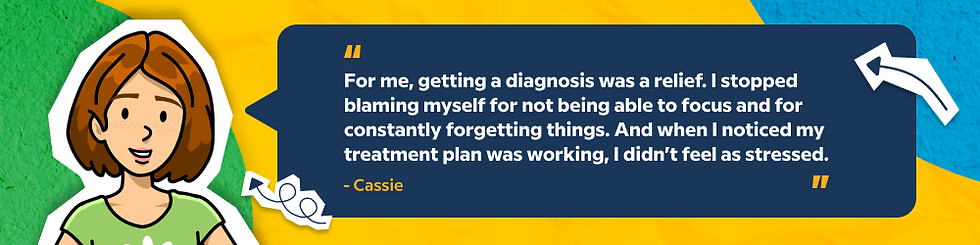
Representations like Cassie’s give students a mirror—a chance to see themselves not as a punchline but as part of a fuller story. They may see themselves reflected in her curiosity, creativity, distractibility, and brilliance.
Sara Rutherford, a BrainPOP employee, explains that she also spent her youth believing her “lack of focus” and “impulsiveness” were flaws rather than differences.
“Seeing myself reflected on screen would have quieted my inner critic and given me the terminology I needed to discuss my struggles.”
These representations also give other students a window into their peers. They might realize that the classmate they thought was “silly,” “loud,” or “can’t sit still” is actually navigating something real—not bad or weird, just different. Cassie helps turn a label into language.
“Knowing that Cassie has ADHD lets you see all the movies she hosts in a new light,” says Palmer. “She has this genuine enthusiasm that makes her want to share everything she knows with you.”
And it’s not just Cassie: in the movie, students learn about other notable figures who have an ADHD diagnosis: Bill Gates, Emma Watson, Simone Biles, and Trevor Noah. That kind of understanding builds empathy, shifts perspective, and helps create classrooms where differences are recognized instead of misjudged.
Why We Made This Movie
While ADHD may not appear in every curriculum, it does appear in every classroom. And that’s exactly why BrainPOP exists: to build background knowledge that helps kids make sense of both the world around them and the world within them. Our ADHD topic is one example of that mission in action.
This movie also circles back to BrainPOP’s roots. Dr. Avraham Kadar originally created BrainPOP to help his young patients understand complex diagnoses through animation. Our ADHD topic carries that same spirit forward—keeping the science current, using expert-backed language, and revising until the very last frame to reflect new research.
The ADHD movie shows how a BrainPOP movie connects kids’ innate curiosity and builds new understanding. That’s what’s behind every topic—from media literacy to the American Revolution to the scientific method—helping kids build knowledge they can see themselves in, talk about with confidence, and carry into the world.
When Learning Feels Personal
You don’t have to have ADHD to connect with this movie. But as the girl who would have loved to have Cassie in my corner growing up, I know how much it matters to feel seen.
“Neurodivergent representation, especially in educational media, is so important,” says Sara. “Showcasing neurodivergent characters fosters inclusion and belonging, reduces stigmas, and inspires empathy in classrooms.”
That’s why kids love learning with BrainPOP—and why teachers return to it again and again. Our topics remind students that learning isn’t just about knowing more; it’s about understanding yourself, your world, and the people around you.
Michelle Strom is the Associate Director of Product Marketing at BrainPOP. As a former teacher with her master’s in Educational Psychology, she’s passionate about how children’s media can open doors for all kinds of learners.


Comments