How BrainPOP Builds Portrait of a Graduate Skills

Updated: Oct 1

Today's students are navigating a world characterized by an ever-evolving digital landscape. To thrive in this environment they require a robust set of skills that empower them to adapt, innovate, and contribute meaningfully. The "Portrait of a Graduate" framework recognizes this and outlines key competencies—such as critical thinking, communication, collaboration, and digital citizenship—that are essential for this generation's success in college, careers, and civic engagement.
And, at BrainPOP, building background knowledge is never passive. Our resources are designed to spark reflection and discussion—while giving students genuine opportunities to apply and practice the traits and skills of a Portrait of a Graduate across all content areas.
Portrait of a Graduate Skills in Action with BrainPOP
Let's explore how BrainPOP empowers students to become innovative, resilient, and collaborative graduates—including 💭classroom ideas 💭 from our Curriculum and Instruction Strategist, Bobbi Bear.
Igniting the Spark of the Innovator
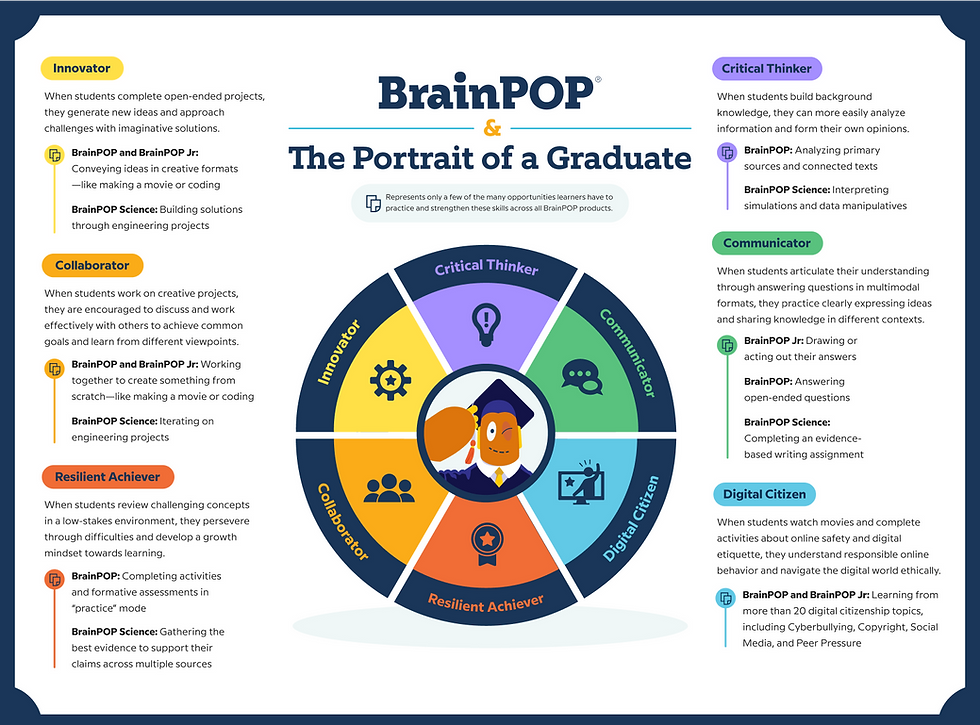
Innovators generate new ideas and approach challenges with imaginative solutions. BrainPOP gives students a variety of opportunities to problem-solve through creation, design, and iteration. With resources like…
Creative Coding and Make-a-Movie, students can convey their ideas in creative formats that empower them to think outside the box.
Engineering projects on BrainPOP Science, students can design and build solutions to real-world problems fostering their ability to innovate and problem-solve creatively.
💭Classroom idea 💭 To foster innovation, encourage your students to use creative tools like Make-a-Movie to synthesize what they’ve learned. For example, after a social studies movie, have them compose a "Main Idea Minute."
Here’s how it works: before they start creating, use the "One Word, One Question" strategy. Give students a sticky note and challenge them to write one word that represents the most important idea from the lesson. On the back, they should write one question they still have. This quick, pre-creation activity helps them distill the information and focus their thoughts.
Then, in a "Main Idea Minute," students can then share a headline for the historical event they learned about, the key term they selected, and their unanswered question. This pushes them to not only understand the content but to also express it in a new, creative way.
Cultivating the Collaborative Spirit
Collaborators work effectively with others to achieve common goals and learn from different viewpoints. They are encouraged to discuss and work with others to create something from scratch. In BrainPOP, students work together to:
Create something from scratch with tools like Make-a-Movie or Creative Coding.
Iterate on engineering projects in BrainPOP Science, promoting discussion, problem-solving, and teamwork.
💭Classroom idea💭 Cultivate collaboration by assigning a small group of students an engineering project in BrainPOP Science. The educator can take the role of facilitating while students generate all ideas as part of the brainstorming and prototyping a solution to a problem, step-by-step. This provides a scaffolded environment for them to practice discussing, problem-solving, and teamwork.
Download your own Engineering Design Process handout or poster for your classroom:
Fostering the Resilient Achiever
Resilient achievers persevere through difficulties and develop a growth mindset. They review challenging concepts in a low-stakes environment and work to gather the best evidence to support their claims. With BrainPOP, students can:
Complete activities and formative assessments in "practice" mode.
Gather the best evidence to support their claims across multiple sources in BrainPOP Science.
💭Classroom idea 💭 After students' first attempt at an activity, like Vocab Builder, review the results and identify misconceptions. Provide small or whole group instruction focused on those misconceptions. Finally, reassign the activity so students can apply what they have learned, clear up misconceptions, and build confidence.
This approach encourages students to try again and have an opportunity to improve their grade. In BrainPOP Science, guide students to collect and review multiple observations before finalizing their claim-evidence-reasoning response, reinforcing the idea that gathering the best evidence is a process of refinement and perseverance.
Nurturing the Critical Thinker
A critical thinker analyzes information and forms their own opinions. They go beyond memorization by actively engaging with real-world information to analyze, interpret, and evaluate it. BrainPOP fosters critical thinking by having students:
Analyze primary sources and Connected Texts*.
Interpret simulations and data manipulatives in BrainPOP Science.
💭Classroom idea 💭 Spark discussion with Primary Sources from BrainPOP. After students have analyzed a source, encourage them to think critically about the information they've just received. A powerful way to do this is to have them unpack the personal story within the document by creating a storyboard.
Using a prompt like, "How does this primary source add a personal story or a specific detail that helps bring the bigger ideas from the BrainPOP movie to life?", guide students to create a storyboard that visually narrates the personal story. This activity helps students break down the document into key moments and visualize the narrative.
Empowering the Effective Communicator
A communicator articulates their understanding through multimodal formats. They practice clearly expressing ideas, sharing knowledge, and showing what they know in different contexts. With BrainPOP, students can:
Draw or act out their answers in BrainPOP Jr..
Answer open-ended questions in BrainPOP Jr. and BrainPOP 3-8.
Complete an evidence-based writing assignment in BrainPOP Science.
💭Classroom idea 💭 Students can show their understanding in a variety of ways using BrainPOP's creative tools. Using features like "Draw About It," "Write About It," or "Act It Out" in BrainPOP Jr. lets students express what they know. For older students, a claim-evidence-reasoning assignment in BrainPOP Science helps them practice communicating their scientific understanding in a clear, structured way.
After completing their chosen activity, students can engage in a digital gallery walk, observing their classmates' work. This is a powerful way for them to learn from each other. Following the gallery walk, have students share:
“One additional thing I learned about this topic from a classmate's work...”
“One question I still have about this topic...”
This approach not only provides students with a choice in how they demonstrate their understanding but also fosters a collaborative learning environment where they can build on each other's knowledge.
Shaping the Digital Citizen
A digital citizen understands responsible online behavior and navigates the digital world ethically. They learn about online safety and digital etiquette. BrainPOP helps students become digital citizens by:
Providing over 20 digital citizenship topics, including Cyberbullying, Copyright, Social Media, and Peer Pressure.
Offering movies and activities that teach responsible online behavior.
💭Classroom idea 💭 Assign the Digital Etiquette topic on BrainPOP 3-8. Have your students watch the movie and use Creative Coding to create a public service announcement on the power of digital etiquette, helping them build a foundational understanding of responsible online behavior. Set up a gallery walk for students as a way to start a classroom conversation about navigating social media and cyberbullying safely and ethically.
Empowering Future-Ready Learners with BrainPOP
BrainPOP cultivates the skills of the Portrait of a Graduate by providing students with the background knowledge and practice they need to become future-ready citizens. Through fostering critical thinking, communication, collaboration, and resilience, BrainPOP helps students build the durable skills essential for success beyond the classroom and throughout their lives.
*Connected Texts include optional AI reading scaffolds that provide students with simplified sentences and definitions for any word or sentence. All AI functionality in BrainPOP products are configurable and can be turned off to meet local needs and policies.
Mar y Sol Esparza is on the Marketing team at BrainPOP, and a former teacher and curriculum writer. She holds a Bachelor’s of Science in Education and Social Policy from Northwestern University. Mar y Sol's favorite BrainPOP character is Annie.


Comments