Reimagining the Screen Time Debate in the K-8 Classroom

Updated: Oct 1
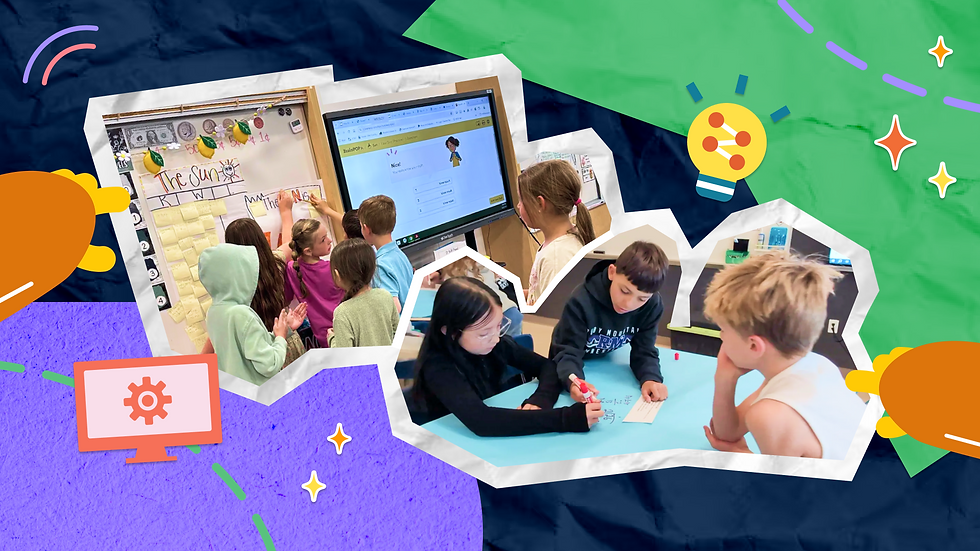
If you scroll through education news or attend a district school board meeting today, you are guaranteed to hear one topic raised above almost all others: screen time. Educators, parents, and policymakers are locked in a fierce debate about the hours students spend in front of devices. We worry about passive scrolling, the loss of human connection, and whether technology is helping or hurting our kids.
As a former educator, I share these concerns! If “screen time” in a classroom means plugging kids into headphones and letting them scroll through media or click through digital worksheets while the teacher catches up on grading, then we have a problem. That kind of mindless consumption doesn’t move the needle on teaching or learning.
At BrainPOP, we believe that instead of tracking the quantity of minutes spent looking at a device, we should be interrogating the quality of the interaction. It’s time to shift the narrative from “screen time” to “learning time” and insist on learning experiences that require meaningful cognitive work, using technology in truly transformational ways.
Framing the Debate: The SAMR Model
If you're a K-8 teacher or instructional coach wrestling with how to use technology well, this debate isn't abstract—it plays out in your classroom every day. To understand the difference between meaningful and meaningless screen time, it helps to use a framework many educators know well: the SAMR model.
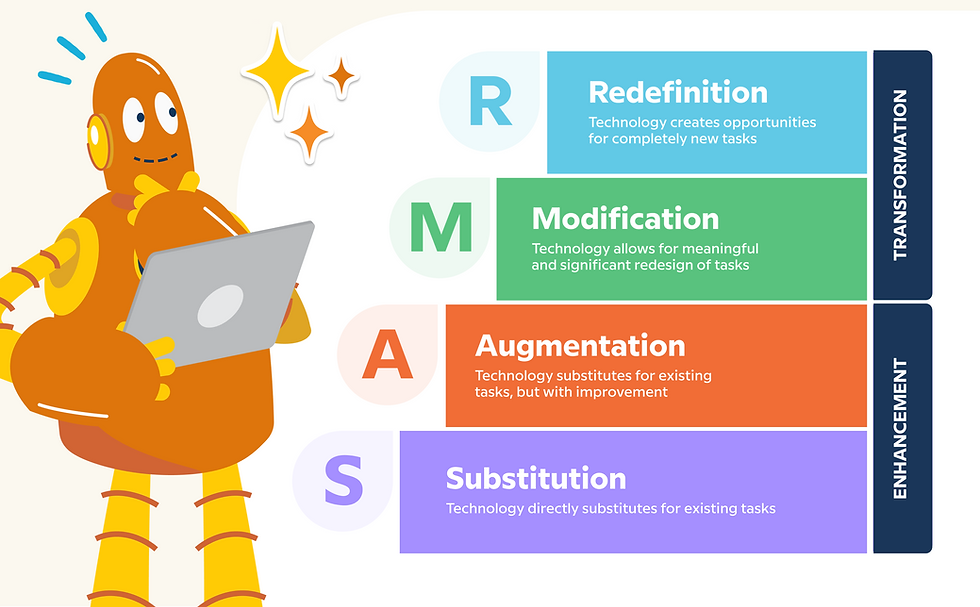
Developed by Dr. Ruben Puentedura circa 2006, SAMR stands for Substitution, Augmentation, Modification, and Redefinition. It's not just a useful lens for evaluating how technology impacts the classroom—it gives us a shared vocabulary for distinguishing the kind of screen time worth defending from the kind worth rethinking.
When screen time gets a bad rap, it’s usually because the technology is simply a substitution for the traditional. This is the not-good screen time—a digital worksheet simply replaces a paper one. In other words, technology changes the medium, but it doesn’t change the task and it doesn’t enhance the learning.
To make screen time truly meaningful, we have to push up the ladder: Augmentation, Modification, and Redefinition. This is where technology fundamentally transforms what students are capable of doing, as opposed to simply replacing old tools.
At BrainPOP, our goal is to help teachers break out of the Substitution trap and move into transformative learning.
BrainPOP Movies as Instructional Augmentation
When Tim and Moby explain complex scientific phenomena, dive into historical turning points, or break down foundational math concepts, they aren’t just delivering information; they are building schema with research-based techniques.
The magic happens because of the intentional pedagogy infused into the movie: anchoring lessons in narrative, scaffolding complex ideas with the combination of audio and visuals that creates dual coding, and providing shared background knowledge that every student in the room can access together.
It is an intentional instructional choice that brings concepts to life in a way that meaningfully improves upon what printed text, pictures, or a teacher-led explanation could ever do alone.
And it sparks the kind of deep classroom conversations that make for compelling lessons. That’s why we designed our Unplugged Activities to seamlessly bridge the digital experience with real-world, face-to-face classroom connection.
BrainPOP's Unplugged Activities provide three core instructional phases that transform a movie into a community experience:
Introduce: Activities that spark curiosity and activate students' prior knowledge before the movie even starts playing
Guide: Prompts and pause-points that help teachers steer students through the movie content with rich, meaningful discussions, turning viewing into an active conversation
Deepen: Post-movie strategies and extensions that challenge students to apply what they've learned, debate concepts, and synthesize new ideas together
This purposeful design supports teachers in facilitating BrainPOP exactly the way it’s intended: as a launch point for building robust background knowledge, supporting content acquisition, and accelerating literacy across the curriculum.
Modification to Support All Learners
Of course, a lesson doesn’t end when the movie credits roll. This brings us to another critical piece of the screen time puzzle: what are students actually doing on their devices when they interact with an educational platform?
Technology allows tasks to be individualized and scaffolded to meet every student where they are. In BrainPOP’s Connected Texts*, students interact with rigorous, grade-level reading material that builds directly on the movie’s vocabulary—complete with word- and sentence-level reading scaffolds that foster student agency and deepen comprehension in ways a static worksheet simply can’t. And the Immersive Reader tool provides accessibility features, read-aloud, and translation to ensure that every student—regardless of reading level or language background—can fully engage with the content.
Reaching Redefinition: Students as Creators
Tools like Make-a-Movie and Creative Coding allow students to do what was once inconceivable in a traditional classroom. Students script, animate, and code to explain their understanding, transforming their screen into a digital canvas for critical thinking.
Consider what this looks like in practice: a third grader who just watched a BrainPOP movie on the water cycle doesn’t just answer comprehension questions—she writes a script, records a voiceover, and animates her own explainer movie to teach the concept back to her classmates. A fifth grader studying the American Revolution builds a digital museum exhibit, making deliberate choices about cause and effect as he programs each element. These aren’t enrichment activities for early finishers. They are the lesson. The act of creating is the demonstration of understanding.
This is Redefinition in its truest form: technology isn’t replacing or enhancing a traditional task—it’s enabling something that simply couldn’t exist without it. When students become the authors, animators, and engineers of their own learning, they move from consumers of content to producers of knowledge. That shift changes everything about how they engage.
The Verdict on Screen Time
Devices are a permanent fixture in the modern world, and banning them ignores the incredible opportunities they present. The solution isn’t to disconnect the classroom entirely; it’s to ensure that every pixel serves a pedagogical purpose.
None of this happens without a teacher making intentional choices at every step. The technology is only as powerful as the person wielding it—which is why equipping teachers with the right tools and the right frameworks matters just as much as the tools themselves.
When digital content is high-quality, teacher-driven, and paired with active, community-building learning experiences, it’s an engine for equity, background knowledge, and joy. Let’s stop counting the minutes, and start making the minutes count.
*Connected Texts include optional AI reading scaffolds that provide students with simplified sentences and definitions for any word or sentence. All AI functionality in BrainPOP products are configurable and can be turned off to meet local needs and policies
Deb Rayow is the Vice President of Learning and Content Strategy at BrainPOP, with a Bachelor's in Child Development and a Master's in Elementary Education. She is an avid solver of mystery puzzle boxes and aspires to someday be a judge (not a contestant) on a Food Network baking show. Deb's favorite BrainPOP character is Nat.


Comments