The Science Behind BrainPOP: Why Animated Educational Movies Make Learning Stick

Updated: May 12
When you see a student's eyes light up during a BrainPOP movie, you're witnessing more than just engagement—you're seeing learning science in action.
Every minute of a BrainPOP movie, every beep from Moby, and every relatable dilemma Tim or Annie faces is rooted in research about how kids actually learn.
So what's actually happening when a student watches a BrainPOP movie? Here's a look under the hood at four pillars that make our movies work.
We're Wired for Story: The Power of Narrative
Think about the last time you tried to memorize a timeline of dates for a history exam vs. the last time you watched a documentary about a revolution. Which one stuck? For most of us, it's the story.
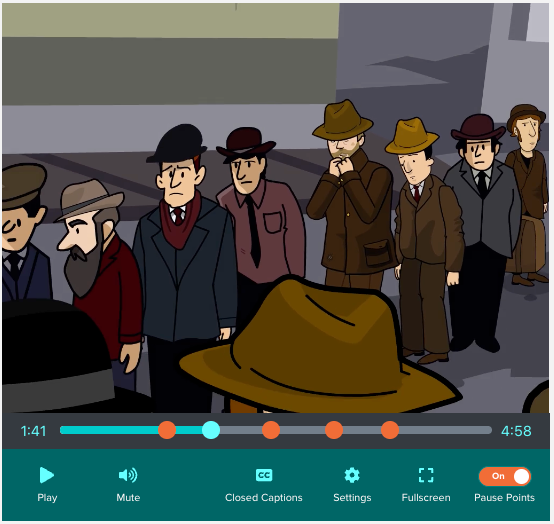
Take our Great Depression movie, for example. Tim is answering a letter about what life was like during the Depression.
He starts by describing what it was—then follows how people across the country were affected: the city streets full of unemployment and breadlines, men rode freight trains to find work where they could, and farmers were hit with a drought that would turn into the Dust Bowl.
As you can imagine, following these stories of real Americans doing their best gives the movie a sense of pathos—and fills students with empathy.
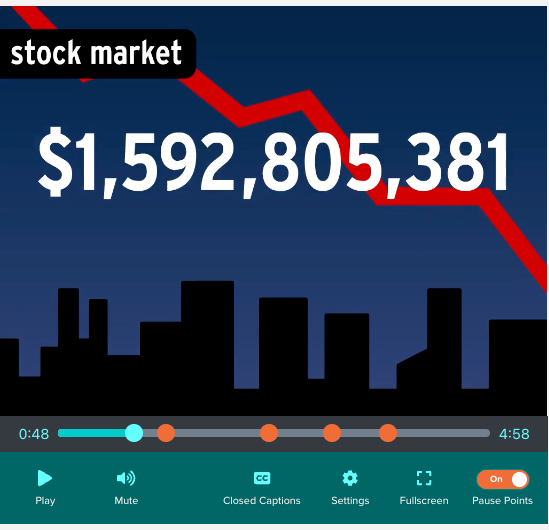
But something interesting is also happening: students are learning what a stock market is, and why it matters; they’re learning that in 1932, one in four Americans were out of work.
They’re learning about FDR’s terms and programs of the New Deal—about unemployment insurance and the role of Social Security.
In short, they’re learning about big, important stuff. But they don’t feel like they are: in the movie, the economic concepts don’t read as abstract data points, they're felt through Americans’ real lived experience.
Why does this work? Because our brains are built to organize information through narrative. And research backs this up:
A 2024 study found that students who watched the story-based versions of instructional content significantly improved knowledge retention, transferability, and engagement with the learning.
A 2025 study showed that the structure of a story actually changes how the brain encodes memories.
So while stimulation-heavy media may grab attention, the learning often fails to stick. BrainPOP takes a different approach by prioritizing 'conceptual' storytelling—focusing on the 'why' and the 'how' through the relatable dynamic of Tim and Moby.
This specific structure doesn't just make the lesson fun; it recruits the brain's meaning-making networks, creating memory pathways that are not only stronger, but more accessible when students need them.
Making the Invisible Visible: Visual Scaffolding
Animation is sometimes dismissed as "just for kids," but in learning science, it's a powerful tool—especially for concepts you can't see with the naked eye.
Think about atoms, the flow of electricity, or even the structure of a persuasive essay. These are invisible structures and processes. Asking a student to picture them from a paragraph of text is asking their brain to do a lot of heavy lifting before learning begins.
Our animations help take that load off. Look at the example below—an excerpt from the Electric Circuits movie.
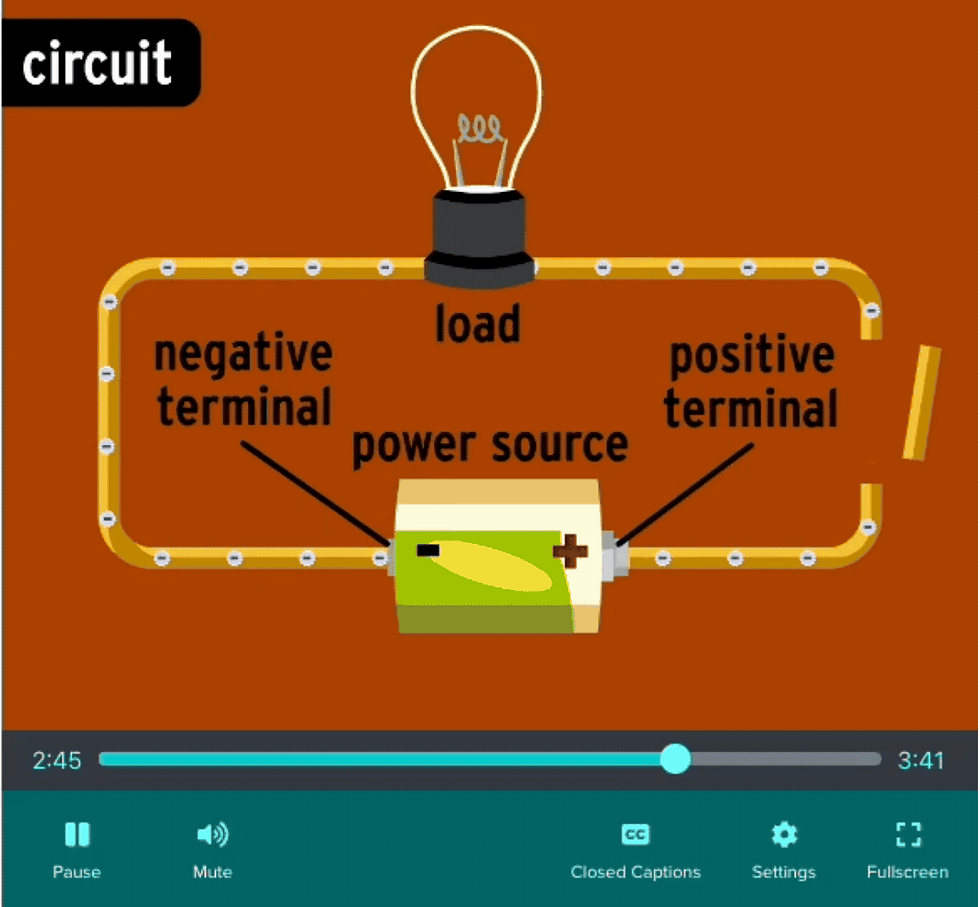
A textbook can show a static circuit diagram, but our movie shows what's happening inside the wire—and the student isn't decoding a diagram, they're watching the process unfold in real time while Tim explains it in plain, kid-friendly language.
They're leveraging a principle called dual coding, developed by Allan Paivio and Richard Mayer.
When a student hears Tim explain a concept while simultaneously seeing an animation illustrate it, they’re getting the information both verbally and visually. This enables better retention and understanding because the information is “encoded” twice.
Respecting the Brain's "Buffer"
Pacing
We've all experienced “information overload.” In learning science, there's a name for why that happens: cognitive load. The core idea is pretty intuitive—our working memory (the brain's active processing space) can only handle so much at once.
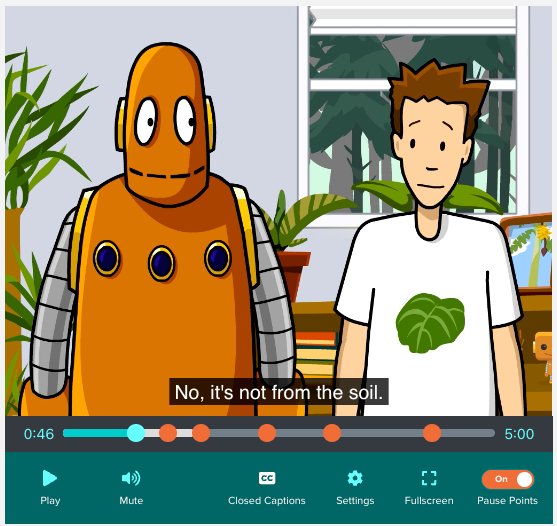
Let’s take the Photosynthesis movie as an example.
It starts with a low-stakes question that activates students’ prior knowledge and creates a safe learning environment—“Where do redwood trees get their mass from?”—and clears up potential misconceptions that it’s because of the soil.
The table for learning is set.
Tim unfolds the narrative intentionally, and not-too-fast, and Moby’s “beep” interjections provide moments for him to slow down even more to clarify or redirect the learning into a more concrete example.
In BrainPOP movies, the scriptwriters, voice actors, and animators are always conscious of giving students space. They take into account how much information they’re showing, and how much time a kid might need to process that information—as well as how much time a joke sits, or a moment of anticipation builds. BrainPOP movies are also intentionally short—typically three to eight minutes.
Varied Reinforcement
But intentional length alone isn't enough; you also need reinforcement—and how you reinforce matters. Research on mnemonic variability shows that encountering a concept through multiple framings — not just repeated exposure to the same explanation — builds richer, more connected understanding that's far more likely to transfer to new situations.
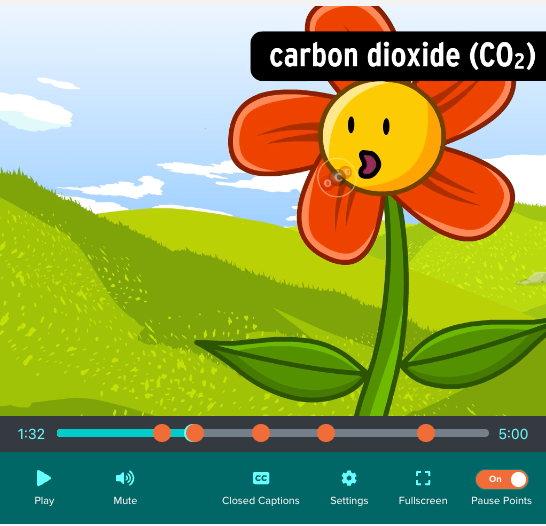
In the photosynthesis movie, the concept of energy conversion through photosynthesis is introduced, revisited, and brought home through three different framings.
First, it’s introduced like a magic trick that makes entire forests out of thin air—an imaginative hook that introduces but doesn’t overexplain. Then, it’s analogized to breathing—”but kinda backwards from how animals like us do it.”
This creates a memorable frame, but it doesn’t stop there. It’s shown with a rabbit exhaling towards a flower, and the flower breathing in the same air—so students see the exchange, not just hear about it. Finally, students hear about it through a joke that plants basically live on candy—helping solidify students’ mental models while making them giggle.
As you can see, each pass gives the brain a new pathway to encode the same idea. When that student encounters energy conversion in a different subject in a few weeks, they've got multiple mental hooks to grab onto—which is what makes knowledge transferable, not just memorable.
That's the difference between watching a video and building understanding. And it's why those five minutes pay off long after the movie ends.
Humor with a Purpose: Why Laughter Opens the Door
You might think Moby's beeps and antics are just there for a laugh, but humor is actually one of our most effective learning tools—and the research backs this up.
Research shows that humor doesn't distract from the hard stuff. It gives students permission to lean into it.
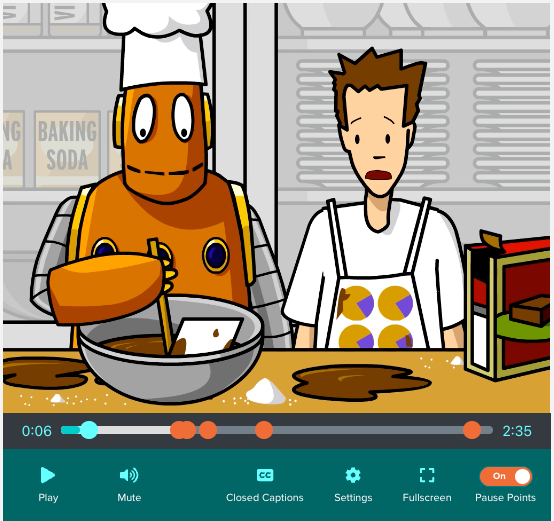
In our Multiplying and Dividing Fractions movie, the whole thing kicks off with Moby making brownies and finding a letter in the mixing bowl.
The humor is situational, pairing an intimidating math concept with a relatable, silly situational comedy concept.
And this situation has stakes! Moby has invited too many guests, and they need to solve the math problem to properly host them.
Suddenly, the math doesn’t feel like a problem—it feels like something fun to solve for delicious stakes.
This is the science behind the humor: When students are stressed or anxious about a difficult subject (looking at you, long division!), their “affective filter” goes up—a concept originally described by linguist Stephen Krashen. When that filter is high, learning slows down. Students are so busy worrying about getting it wrong that they can't focus on getting it right.
Research published in Advances in Physiology Education found that humor reduces stress and anxiety while boosting alertness, creativity, and memory. A 2025 review in Frontiers in Psychology surveyed five decades of instructional humor research and confirmed the pattern: humor enhances engagement, motivation, and recall.
In other words, when students laugh, they relax. When they relax, they're more open to taking risks with challenging material. And when they're willing to take risks, that's when real learning happens.
It's the same reason Moby's reactions to increasingly complex problems in our Division movie work so well: his confusion mirrors what many students feel, normalizing the struggle. Plus, it sparks Tim to explain it in a different way—helping the students in the room who didn’t get it another path to understanding, without any sort of shame.
The Bottom Line
At BrainPOP, we believe that for learning to be effective, it has to be accessible. And “accessible” doesn't mean dumbed down—it means designed around how the brain actually works.
The conversation around screen time has also shifted. The American Academy of Pediatrics now encourages educators and families to focus less on counting minutes and more on the quality, context, and purpose of the media kids are using. By grounding our movies in narrative, dual coding, managed pacing, and purposeful humor, we're designed to meet that standard. Those few minutes in the classroom are doing real cognitive work.
So the next time you hear Moby beep, know that there's a whole lot of science behind that sound.
Want to learn more about what goes into BrainPOP movies? Learn more about how topics are selected—then how each movie is researched and written, then meticulously animated, to break down even the most complex subjects in a way that students understand, remember, and love!
Deb Rayow is the Vice President of Learning and Content Strategy at BrainPOP, with a Bachelor's in Child Development and a Master's in Elementary Education. She is an avid solver of mystery puzzle boxes and aspires to someday be a judge (not a contestant) on a Food Network baking show. Deb's favorite BrainPOP character is Nat.


Comments