How Do You BrainPOP? 3 Ways to Spark the "Aha!" Moment

Updated: Oct 1
Step into any school using BrainPOP, and you’ll witness a vibrant, varied landscape of learning. You might find a science teacher pausing a movie for a lively whole-class discussion on photosynthesis, while down the hall, social studies students are individually exploring John Adams’ role in government at a learning station. Meanwhile, a group of curious learners in the library could be deep-diving into a self-directed research project on ancient civilizations.
None of these approaches is wrong. In fact, they are all exactly right.
As educators, we know that there is no single blueprint for a perfect lesson. When schools ask us about the best way to implement BrainPOP, our answer always starts with a question: What are your instructional goals for the lesson?
Because each classroom has its own rhythm, and a teacher’s decision to use whole-group lessons, targeted small-group instruction, or independent student work via station rotations or centers depends entirely on what their students need in that exact moment.
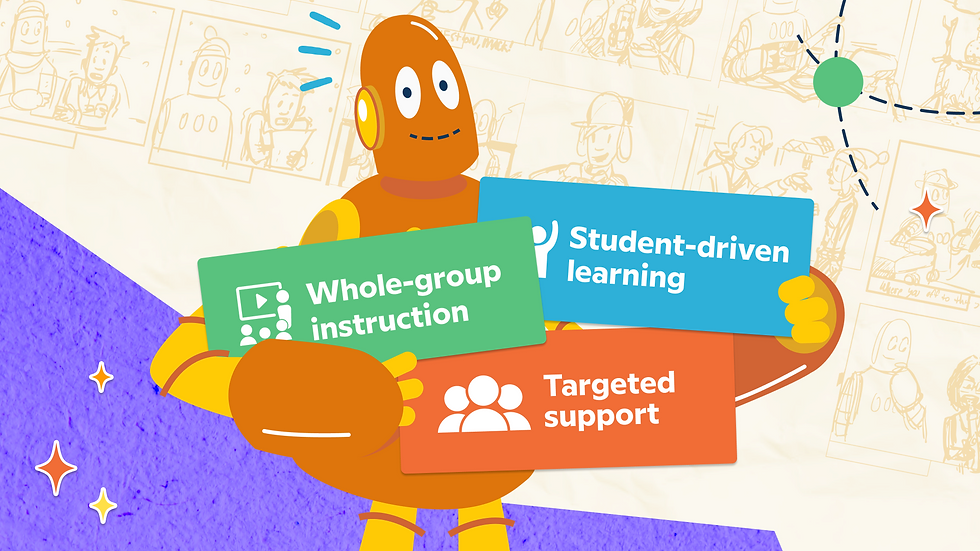
To help educators hit those targets without adding more to their plates, here are our three flexible implementation models designed for purposeful, impactful planning.
Whole-Group Instruction
What it is: Teacher-facilitated instruction where a movie serves as the launch point for background building, discussion, and whole-group activity.
Think of this model as the ultimate community builder. It is ideal for launching new units, kicking off lessons when you have shared device carts, or introducing younger learners in K–3 grade bands to complex ideas.
By gathering the whole class around a shared concept, teachers can immediately establish instructional equity—ensuring every student, regardless of their starting point, has the same high-quality background knowledge. This collective experience lowers the barrier to entry for complex topics, making classroom discourse more inclusive.
These systems (and other activities, like Movie + Pause Points and Live Mode quizzes) take passive viewing and turn it into an interactive conversational sandbox. When teachers guide students through a shared reading of Connected Texts*, it opens a gateway to complex topics. Students aren't just memorizing facts; they're building the vocabulary they need to confidently speak the language of a scientist or historian.
Targeted Support
What it is: BrainPOP acting as a digital station, homework tool, or learning center where students set their own pace while teachers monitor and intervene as needed.
When you need to differentiate instruction or meet students where they are, putting them in the driver's seat is incredibly powerful. This model shines in station rotations, intervention blocks, virtual school environments, and even sub plans.
In this model, the content can be adjusted to individual student needs, moving them from surface-level recall to deeper critical thinking. For older students in grades 3+, activities such as the Leveled Quiz, Primary Sources, and Connected Texts, as well as creative outlets like Make-a-Movie and Creative Coding, encourage advanced analysis and student agency.
For young learners using BrainPOP Jr., features like Word Play for vocabulary practice, Read About It for paired nonfiction texts, Write About It for journaling, and Draw About It offer accessible multimodal routes to mastery.
Data to Differentiate
Transitioning into the driver's seat gives students the agency they crave while providing administrators and coaches with a window into authentic growth. By providing usage and assignment data, the educator dashboard offers a snapshot of real-time student progress. This visibility empowers you to draw your own insights and pivot instruction with confidence—advancing learners who are ready for a challenge while providing immediate, scaffolded support to those who need it most.
Student-Driven Inquiry
What it is: Provides discoverable resources that fuel student-led research and inquiry-based learning right in the classroom. This model is the perfect fit for student choice days, media center exploration, or anytime you want to let kids chase their own curiosity.
Students browse topics that excite them and pair their visual learning with Connected Texts, Primary Sources, or the Vocab Builder. For K–3 students, discovering Belly Up comics, Word Play, and choice-reading prompts turns independent exploration into an authentic literacy and learning adventure in any classroom environment.
Finding Your Perfect Fit
There is no rulebook that says a school—or even a single teacher—has to stick to just one of these models. You might start your week with a whole-group launchpad on Monday to build collective background knowledge, transition to independent learning stations on Wednesday to reinforce skills, and open the floor to student-driven inquiry on Friday.
The power of these models lies in their ability to keep cognitive load manageable while maximizing student engagement. By blending storytelling, visual scaffolding, and flexible activities, you can build a classroom environment where every student experiences that thrilling moment of discovery.
Which model are you excited to try next in your building?
*Connected Texts include optional AI reading scaffolds that provide students with simplified sentences and definitions for any word or sentence. All AI functionality in BrainPOP products are configurable and can be turned off to meet local needs and policies
Bobbi Bear is the Head of Implementation Strategy at BrainPOP. With over 20 years of experience in educational thought leadership, she is dedicated to helping teachers and administrators worldwide use BrainPOP to transform instruction and deepen student learning. She is a fan of coffee, theater, and Irish Setters. Her favorite BrainPOP character is Tim because of his curiosity for the world around him.


Good