Beyond the Prompt: Why AI Literacy is the New Critical Thinking

Updated: Mar 26
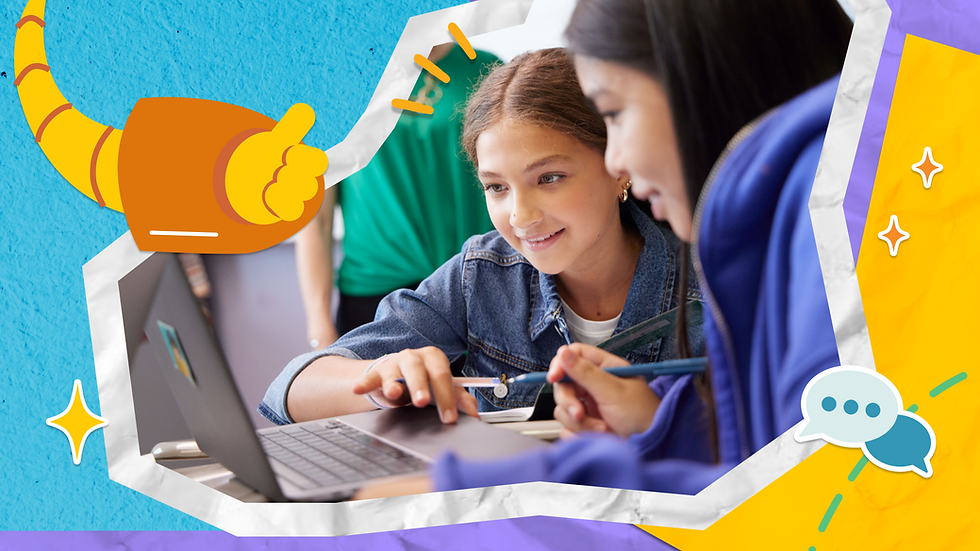
We’ve all seen it: a student uses an AI image generator to create a “photograph” of a historical event that never happened, or uses a chatbot to “summarize” a book they haven't read. In the faculty lounge, the conversation usually centers on one thing: AI fluency. We talk about how kids are using these tools, how “AI-fluent” they seem to be, and how we can possibly keep up with their proficiency.
But there’s a massive gap between operating a chatbot and actually understanding what’s happening under the hood. At BrainPOP, we believe that before students use AI, they should understand AI.
AI Fluency vs. AI Literacy: What's the Difference?
It's easy to mistake a student's ability to navigate a new tool for true understanding. However, there is a vital distinction between AI fluency and AI literacy.
AI Fluency: This is the “how-to.” It’s about operating the tools—knowing how to write a prompt, use autocomplete, or edit a photo.
AI Literacy: This is the “why” and the “what.” It’s about understanding that AI doesn't know things.—it predicts patterns. It doesn't understand information.—it processes data.
The risk isn't just that students are using AI; it's that they are using it without a foundational understanding of how it works. Without that foundation, they might accept AI outputs uncritically, fail to fact-check, or over-rely on tools they can't actually evaluate.
Why AI Literacy Belongs in Every Subject
State mandates are already arriving, directing schools to embed AI literacy across the curriculum. More than half of all U.S. states either have guidance or are in the process of creating it. But let’s be real: few schools have extra time in the school day for a new standalone class on AI Literacy.
But AI literacy isn't a standalone topic. It’s the natural next step in the skills we’ve always taught: media literacy, source evaluation, and critical thinking. It belongs in every classroom because students encounter AI in every subject.
Whether it’s a science simulation or a research project, AI is there. By embedding these concepts into the topics teachers are already responsible for, we make AI literacy a part of the learning journey rather than a disruption to it.
Building the AI Foundation First
Think of it like learning to drive. You don't just hand a kid the keys and hope they figure out the engine while they're on the highway. You want them to understand the rules of the road and how the vehicle actually works first.
That’s why our new AI Literacy Collection—launching Back to School 2026—focuses on true understanding. It answers questions like: why does AI sometimes get things wrong or how does it learn from data? In answering the questions students are already asking about artificial intelligence, Tim and Moby and the rest of the BrainPOP cast step into the role BrainPOP has always played best: making complex topics easier for all students to understand.
Deb Rayow is the Vice President of Learning and Content Strategy at BrainPOP, with a Bachelor's in Child Development and a Master's in Elementary Education. She is an avid solver of mystery puzzle boxes and aspires to someday be a judge (not a contestant) on a Food Network show. Deb's favorite BrainPOP character is Nat.


Comments